


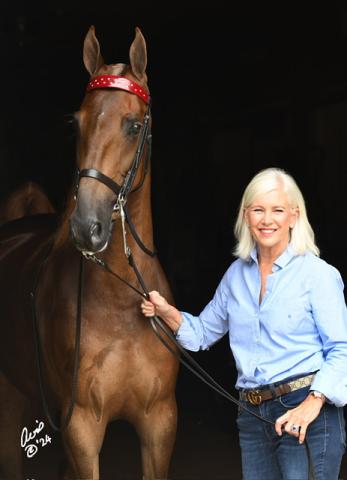
- Details
- Written by: Betty Baird Kregor
- Category: Saddle & Bridle Blog
In the show ring – whether you’re riding a Saddlebred, Morgan, or driving a Hackney pony – your mental game matters just as much as your skill set. And it starts with one simple, often overlooked question:
Why do you do this?
Professional athletes know their “why.” It’s clear, defined, and deeply personal. It might be a love of the horse, the pursuit of excellence, or a commitment to growth. That clarity gives them direction – and more importantly, stability under pressure.
Amateurs, on the other hand, often skip this step. Without a defined “why,” they fall into patterns of reacting instead of leading. Nerves take over. The focus shifts to perfection. One mistake can unravel the entire ride.
But when your “why” is clear, everything changes.
You begin to think more like a professional – with a macro perspective. Instead of riding one class at a time, you see your performance as part of a bigger journey. You ride with purpose, not fear. Mistakes become information, not failure.
Knowing your “why” anchors you. It steadies your mind when the pressure rises. It reminds you that this sport is not about perfection – it’s about progression.
So, before your next ride, take a moment.
Ask yourself:
Why am I here?
What do I want from this experience?
Because when you know your “why,” your mindset follows – and that’s where real performance begins.
Betty Baird Kregor is a sports performance coach specializing in the mental game for athletes. She helps riders develop confidence, clarity, and a competitive mindset to perform at their best in and out of the show ring. Visit her website to learn more.

- Details
- Written by: Alivia Garwood
- Category: Saddle & Bridle Blog

Lexington, wow. It’s always been one of my favorite shows, whether I am there competing or watching from home. This time I had the privilege of showing Harley in the 14-17 Saddle seat Equitation division, but things for me didn’t go as planned. I was doing some Acro and landed incorrectly. It hurt, but I thought I was totally fine. I mean, I did four lessons and showed in the championship, helping Harley to tackle her first “big girl” pattern, and we did it beautifully. I even did no stirrups. (Ouch.)
- Details
- Written by: Alivia Garwood
- Category: Saddle & Bridle Blog

Woah, what is that canter?! I will never forget the day I tried Harley. Not because of her beautiful head carriage, or her crazy high motion, or even her elegant conformation, but because of her insane canter. I tried her in a snaffle bridle with one rein and a martingale and only cantered down one rail. It was a struggle to get her into the gait, and once I finally did, I had no idea what I was about to deal with. Her canter was crazy fast, long-strided, lofty, and about impossible to sit. I think I was only in the saddle 20% of the time. She was swapping leads about every stride or two and couldn’t seem to go straight if her life depended on it. She didn’t understand leg, vocal cues, or what my hands and seat were doing to attempt to slow it down. By the time I got around the corner, she fell out of the canter, so we just decided to not try it again.
- Details
- Written by: Alivia Garwood
- Category: Saddle & Bridle Blog
 Photo by Julia Louw.
Many equitation riders want to ride those equitation horses who know their jobs and allow you to concentrate on yourself and your form. My name is Alivia Garwood, and while I understand the desire, as an equitation rider, I do not want that at all.
I have been riding Saddlebreds for six years and I’ve shown in equitation for three years. This season will be my fourth in equitation and my first in the saddle seat equitation division. For the past several years I competed in pleasure equitation on my previous horse RWC CH TSV The Mystery Continues, but I called him Goliath. Goliath was not equitated when we bought him, but he knew the basics, so it took us no time to fully equitate him. In our second season showing together, we Triple Crowned in 13 & Under Pleasure Equitation and he earned his “CH” title. After showing Goliath for my entire equitation career, I made the difficult decision to sell him and search for a new challenge. I found that new challenge – a three-year-old who knew absolutely nothing – at Rose Stables in Shelbyville, Kentucky last December. Her name is RWC New Line’s Captain Marvel, but I call her Harley. I tried her in a work bridle and didn’t even canter, but we saw the potential in her and decided to take the jump and buy her with the intention of equitating her and showing her in saddle seat equitation.
- Details
- Written by: Allie Layos
- Category: Saddle & Bridle Blog
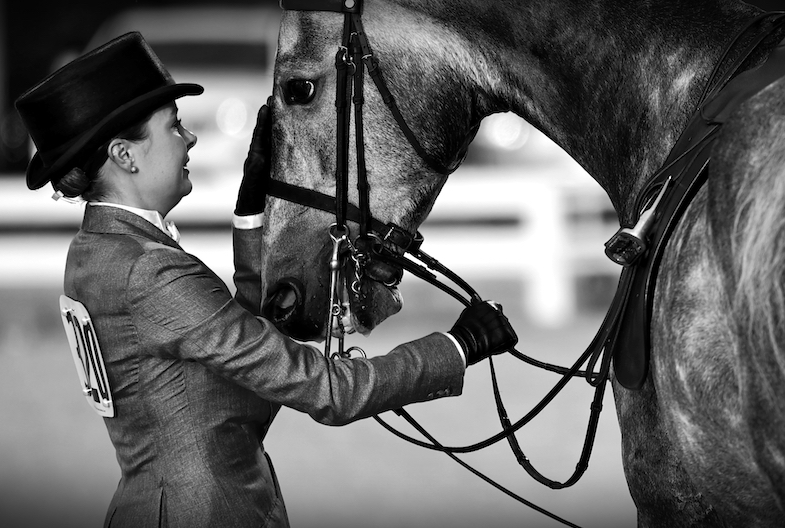 Photo by Julia Shelburne-HittiI’ve been an equestrian all my life; I literally don’t remember a time when I didn’t ride horses, and except for a couple pony rides on a Quarter Horse when I was 2 years old and a semester of western and hunt seat during college, it’s always been saddle seat and Saddlebreds. This means that I’ve spent my entire remembered life trying to explain the saddle seat discipline to others – both horse people and non-horse people. And let me tell you … sometimes … I’m tired.
Don’t get me wrong, I love sharing the joy of horses and my chosen breed and discipline with others. I’ve experienced firsthand the blessings they can bring to someone’s life; I want everyone to know it, and I like to think that I’ve done a fair amount throughout my life to make that happen. But after 30 plus years of trying, sometimes, when it comes to one-on-one encounters, I find myself wanting to disengage from the casual conversation rather than plowing forward into the same old tedium, and I have to ask myself why.